RABBI — JESUS — YOGA
MEDITATION WITH JESUS
Welcome to “Rabbi – Jesus – Yoga”! What’s that? Rabbi Yoga? With Jesus? Let me clarify. Here, “Yoga” does not refer to any of the many forms of hatha yoga that are so popular today. Rather, “Yoga” is used in its more general sense of a spiritual practice, of any kind, that connects us to the divine. Not “yoga for the body” but rather “yoga for the soul”. The meditation practice offered here is inspired by the Tibetan “Guru Yoga”. I gave the exercise I developed the name “Rabbi Yoga”, reflecting the thrust of the original name used in Tibet. There “Guru” means teacher or master, and more specifically “spiritual teacher”. A guru – and Jesus was one – is the living embodiment of Truth. We do not always need to enjoy his physical company; it is more important to keep Him in our heart, to attune ourselves to Him and become one with Him. “Rabbi” – the word used by disciples to address Jesus – has virtually the same meaning. So that’s why. The aim of the exercise is to become one with Jesus and live as He showed us. Rabbi Jesus Yoga helps us lead a life of contemplation. Not just in the seclusion of our mediation area, but in every circumstance of our daily life. This form of meditation is not specifically intended for Christians, but rather for everyone who can recognise themselves in the message of Jesus and experience Him in their heart as a living reality.
What led me to develop this specific form of meditation – Rabbi Jesus Yoga? I have, after all, been following the Zen Buddhist path since 1989; my ordination in 1994 as Zen monk is a testimony to this. And since 2010, after Rabbi Jesus made a sudden and overwhelming comeback into my life in 2005 after an absence of forty years, I have practised “Christian Meditation” in the tradition and style of Fr John Main and Fr Laurence Freeman and I mentor a meditation group working along these lines. I still follow these two paths today. So was I disappointed with my two exercise practices? Not at all! It was just that, after all those years of exercising in the non-dualistic spirit of Zen and Christian meditation, I felt a deep and growing need to extend a personal connection with Jesus and to give it a concrete expression in my meditation practice. Neither exercise obstructs the other; I have no problem in practising them side by side. But perhaps this approach is not appropriate for everyone. A novice may find it better to spend some time focusing on one specific discipline.
The Chinese-Japanese Zen, the Tibetan-Buddhist Dzogchen and the Indian Advaita Vedanta adhere to the most extreme or purist form of non-duality. With non-duality we mean that the reality (G*d) that seems to present itself as a dual(ity) dualistic?, is essentially one. After ten years of practising Zen I took a further step towards austerity and dabbled in advaita vedanta that itself goes beyond meditation practice and focuses exclusively on: Seeing and Being. Advaita had steadily grown in the West since the mid 20th century, and made a major surge forward at the turn of the millennium. A large number of western advaita teachers offered satsang, that is a meeting of teacher and pupil (satsang: being together in Truth), and an endless wave of books from their hand about the “ineffable” flooded the spiritual market. I gorged in three languages on everything I could find and literally gobbled myself into non-duality indigestion. I ended up in spiritual limbo. I felt dry, barren. I had the impression that advaita was taking place in my “head” rather than in my “heart”. I was wandering in the wilderness. Not so much a spiritual crisis, not a dark night of the soul, but an infinite, uninspired shuffling across the hot sand in search of a fresh spring at which I could cool my overheated brain and refresh my heart.
It seemed as if the soul, just as our organic-physiological system that maintains chemical and physical processes in balance, was seeking automatically for its own balance. A sort of built-in self-regulation; “homoeostasis”, they call it. I witnessed that happening to me. Like many things in my life, that balance was restored abruptly and in a somewhat extreme way. Apparently that is the nature of this beast. In this connection, C. G. Jung talks of “enantiodromia”, a chic word for the phenomenon in which the surplus of one active force inevitably incites and brings forth its opposite. In people language: you go from one extreme to the other. The classic yin yang illustration is an example of this. For me, this manifested itself as the unexpected return of Jesus after an overdose of non-duality. He called me and my Zen practice had taught me to say, without hesitation or conditions, “yes” and “here I am”.
I immediately felt the need to develop a type of bhakti or loving dedication around the figure of Rabbi Jesus. All the time I had walked the path of Buddha, I had never succeeded in developing a personal relationship with Shakyamuni or forging an intimate bond between us. But that is not the intention of Zen Buddhism. Of course, in the Buddhist tradition, Shakyamuni Buddha is shown respect, but something like “Buddha Bhakti” is absent. We know the typical Zen statement: “If you meet the Buddha, kill him.” This one-liner obviously has layers of hidden meanings and a deeper significance, but in any case it does not sound particularly bhakti. Or what do you think about this iconoclastic parable? It is winter and exceedingly cold; the Zen monks have almost frozen to their cushions and icicles are growing from their noses. The Zen dojo can no longer be heated, for the entire stock of wood has already disappeared in smoke up the chimney. The abbot cannot endure it any longer. He is so filled with compassion for his frozen pupils that he takes the precious, centuries-old Buddha statue that stands on the altar in the middle of the zendo and, before their startled eyes, burns it to give them some warmth. I cannot really see any priest or abbot burning crucifixes and statues of saints in order to heat their church or monastery. What I mean to say is that in Zen the emphasis is not on a personal bond with the Buddha and a personal relationship with a guru or divinity is exactly the basis of the bhakti path. I nurture a deep respect for the Buddha and regularly offer incense or burn a candle for the Enlightened One, but I never feel really close to him. For some reason, that’s never proved successful. But it did with Jesus. Even though I had lost sight of Him since my adolescence. In next to no time, to be honest from the very start, I felt an intense and mutual emotional link with the Rabbi.
When I gave a lecture for the Flemish department of the World Community (Congregation) for Christian Meditation about the non-dualistic nature of their (and my) exercise and described this form of meditation as “Christian Advaita Meditation”, it immediately unleashed reaction. Some posited that non-dualism seemed reasonably dry, callous or heartless. That there is also something such as a devotional side to spiritual life. That a devotional path can also be a path. And what about devotion to Jesus? Understandable objections. I had not, indeed, included this in my lecture. That could give rise to the impression that “the devotional” is entirely absent from my personal practice, but nothing is farther from the truth. In Christian Meditation the devotional aspects are also kept to a strict minimum. In the best case, a meditation room will contain a Jesus icon, a candle, a single flower. No prayers, no hymns, no rituals, no offerings of flowers. It would seem that in this Christian Meditation is stricter than the Zen tradition, where some of these elements are present. It was clear that some practitioners of Christian Meditation felt the need for some form of “Jesus bhakti”. I am one of them.
Bhakti is Sanskrit for the devotion that a bhakta (“believer”) cherishes for a certain (Hindu) divinity. It is one of the ways in which people aspire to Enlightenment or Liberation. By developing a deeply personal connection with the divinity, the practitioner draws closer to the divine. Bhakti is given shape in puja, a ritual whereby the followers make offerings or direct songs of praise or prayers to a cult image. Bhakti is a highly personal form of worship; it does not require the intervention of a mediator or priest. You immediately notice the similarities with devotional practices of Christians with regards to Jesus, Mary and the saints. Guru Yoga or Rabbi Yoga does not identify itself with Bhakti Yoga, but elements such as devotion and surrender are present in and even essential to both. For me personally, bhakti is also an exercise in humility. After all, I had secretly cherished the unexpressed idea that the non-dualistic path was superior to all others, which is, of course, not so. Is Christian mantra meditation or zen buddhist zazen not enough? It certainly suffices for many people; but people differ and everybody follows his or her own path and evolves in their own specific way. Urges can unexpectedly emerge that have never been felt before. Practising non-dualistic meditation does not, by the way, prevent experienced meditators from praying, from undertaking pilgrimages, from celebrating the Eucharist, from addressing specific saints, and so on. Whether people want to hear it or not, some of us, as non-dualists, need a personal bond, with Buddha or with Jesus. That personal bond is the basis of Guru Yoga, and of Rabbi Yoga.
GURU YOGA
“Guru Yoga” is a meditation practice from Vajrayana or Tantric Buddhism. The Tibetan teachers Sogyal Rinpoche and Dilgo Khyentse Rinpoche have this to say about it: “There is no faster, more poignant or more powerful exercise for summoning the help of enlightened beings, evoking devotion and for realisating the nature of the spirit than the exercise of guru yoga. The words ‘guru yoga’ mean ‘uniting with the nature of the guru’. In practice, we are offered methods that make it possible to merge our mind with the enlightened mind of the master. Invoking your master means amalgamating your heart and mind with the mind of your master and allowing your mind to become one with the truth and the embodiment of enlightenment. The external teacher introduces you directly into the trust of your internal teacher. The more you realise this, the stronger becomes the realisation that your internal and external teacher cannot be separated. That is the reason why all wisdom traditions of Tibet attached so much importance to the practising of guru yoga and all Tibetan masters cherish it as the core of their practice.”
As Zen Buddhist and practitioner of Christian meditation, it was inevitable that I should combine elements from both traditions. I thus do what Fr John Main and Fr Thomas Keating also did: they borrowed a technique for the vedanta – meditating with a mantra or prayer word – to turn it into a practice for Christians. I borrowed elements of the Tibetan Buddhist tradition – guru yoga – in order to practise them in a Christian context. In other words: I do not place the Buddha or Padhmasambava in the centre of the meditation but Jesus. Jesus is my/our Beloved Teacher. Rabbi Yoga does not, however, offer any theological foundation and does not aim for any link to a Christian contemplative technique, as the World Community for Christian Meditation did to Cassianus and the desert fathers or as Centering Prayer did to “The Cloud of Unknowing”.
ASPECTS OF THE MEDITATION
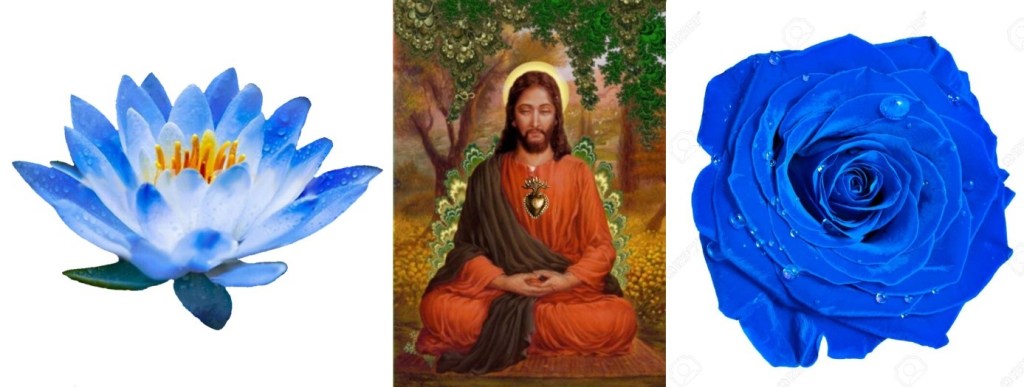
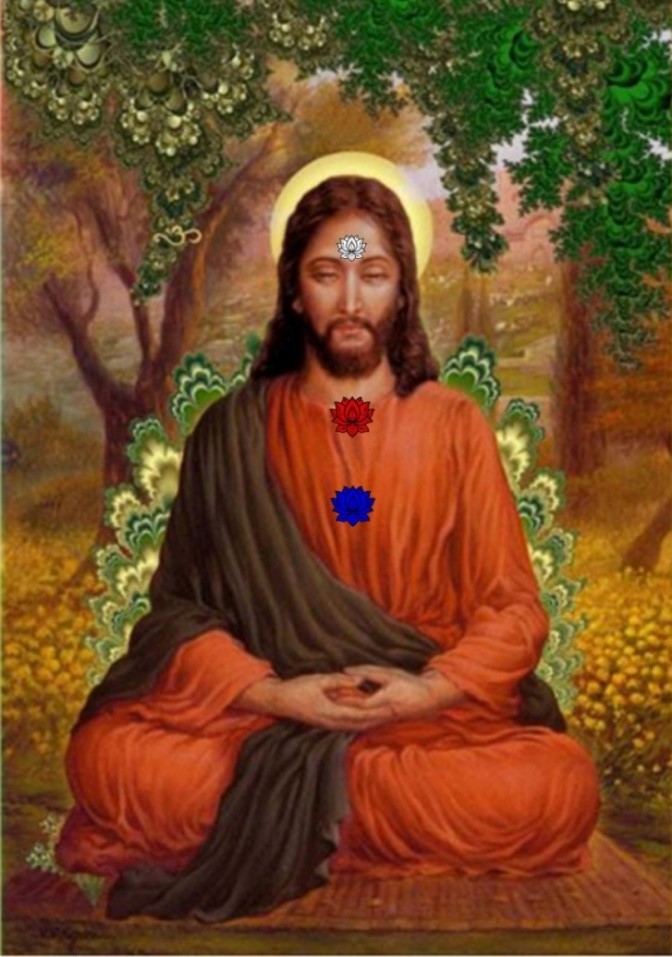
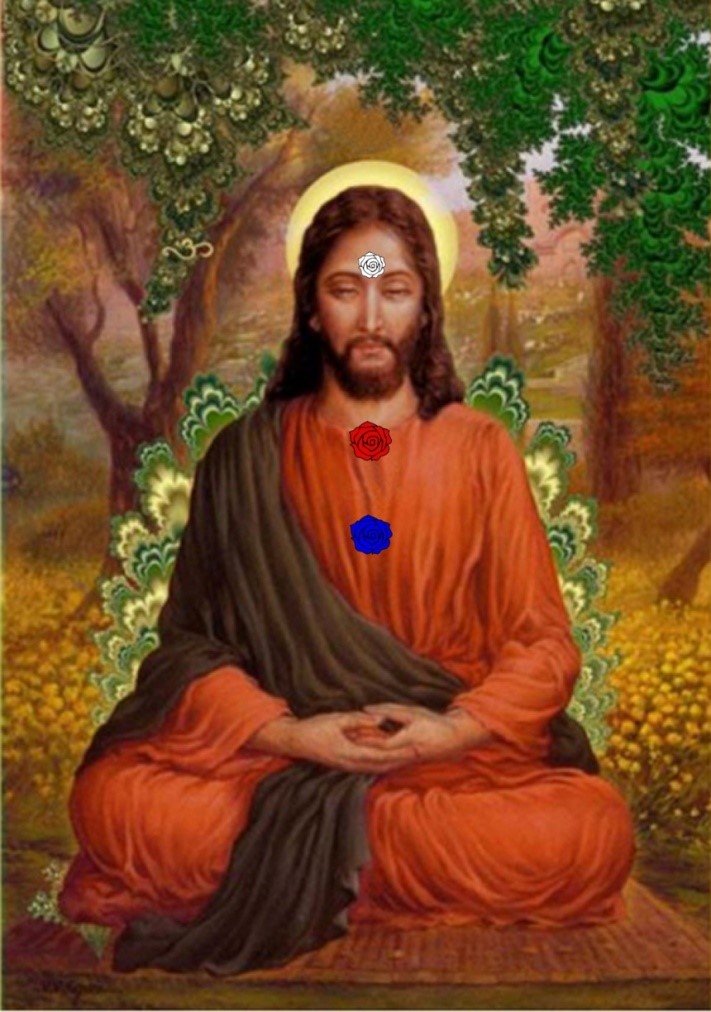
As logo for this new form of meditation – Rabbi Jesus Yoga – I chose the illustration of Jesus in the lotus position, as He is shown on the cover of “The Yoga of Jesus” by Paramahansa Yogananda, a book in which the author provides a commentary on the gospels. From the very first moment that I became acquainted with it, I was struck not only by the beauty of this work of art, but also by the remarkable power that it exudes. As if His “presence” inhabited the visual image. I have added a flaming golden heart to that illustration. You can see this as a reference to the Sacred Heart mystical devotion. The heart represents Jesus’ Life and Passion, while the flame represents Love and Compassion. The path of Rabbi Yoga is, after all, the Path of the Heart, Rabbi Jesus is the opener of hearts. During the meditation, we sit face to face with the same depiction of Jesus, except that the golden heart has been left out and three lotuses or roses have been added (see below).
What led to the choice of this illustration of Jesus in the meditative lotus position? After all, He never meditated or at least not in this position and most certainly not using the method under discussion. And that’s true, but we are not intending an historic illustration, but rather an aid to meditation. I chose Jesus in the lotus position as an element of the meditation technique that is aimed at becoming one with Him. Meditation is my life path and at some point this would have had to be translated into this form. My choice in no way implies a depreciation for the more classic illustrations such as Jesus suffering on the cross or the Jesus of the Sacred Heart devotion, quite the opposite. Personally, I nurture a great dedication to the Sacred Heart and to the Face of Jesus on the Holy Shroud of Turin. If you would like to use a different illustration, you should choose one in which the entire body of Christ is shown or at least the upper body. This is important in connection with the visualisations (see below). Be careful in your choice of illustration, for you will be using it for a long time. It is not recommended to change it frequently for something different. We must become completely familiar with the illustration and all its details. That is something that takes considerable time and it is not facilitated by changing the illustration at the drop of a hat.
It is inevitable to give certain technical explanations about general aspects of the meditation in advance. I will try to formulate this as briefly and simply as I can. Remember that something may seem more complicated “on paper” than it turns out to be in reality; if you practise your “Rabbi Yoga” five times, the technique will become obvious. Anyone wanting to learn more about any of the points stated below can contact me, either a meditation centre of your choice or by means of an Internet search.
- Position
We bring the body to rest by sitting still and upright throughout the meditation – about 20 to 25 minutes. You can take your place on a meditation cushion, a kneeler or a chair. The choice depends on your physical abilities. Whatever you choose: knees or feet (next to each other) firmly on the ground, straight back, shoulders relaxed, neck extended, head upright, chin slightly tucked in, hands resting in your lap or on your thighs. Mouth closed, tip of the tongue against your upper teeth. Eyes closed or lowered. Our position exudes vigilance and dignity. We do not give in to the urge to shuffle our feet, crab at an itch, clear the throat and so on. From start to finish, we sit in complete silence.
- Breathing
Breathing is the basis of all forms of meditation. Our breath is a bridge between body and soul and is an important factor in imparting rest to them both. We breath through our nose, the mouth remains closed. We do not limit our breathing to a superficial shoulder and chest breathing, but descend to the lower abdomen, to the so-called “Ocean of Life Energy” which is located several centimetres below the navel. We continue our natural breathing; a calm inhaling and exhaling. Feel your abdomen rising and falling. We repeat the mantra evenly and assiduously to the rhythm of our breathing in and out (see below).
- Mental spirit
It is a proclivity of our mercurial mind to jump all over the place like some hyperkinetic monkey. So do not attempt to clear or empty your mind, that is an impossible task. To bring a certain degree of calm to the mental spirit, we focus on one thing: our mantra which we recite from start to finish in silence. It is important that, whenever we are carried away in the never-ending swirl of thoughts, we return to our mantra, not 7 times, but 70 x 7 times.
- Mantra
During the meditation, we repeat a mantra or prayer-word. We have chosen the one used within the World Community for Christian Meditation: MA-RA-NA-THA. Maranatha is a Aramaic word and means “Come, Lord Jesus”. We do not think about its meaning, although the inviting message of these words fully match the purpose of our Rabbi Yoga practice. Try to avoid simply reciting the mantra in your mind, but let it echo through your heart It is not without reason that the choice fell on a word rich with sounds. The mantra has, after all, four open syllables. It can be split up into four sections and in this way can easily match the rhythm of breathing in and out. Breathing in: MA, breathing out: RA, breathing in: NA, breathing out: THA. You do not need a clock to tell the time. One repetition of the mala (see below) at the steady pace of breathing lasts 20 to 25 minutes. Feel free to lengthen the meditation time.
- Visualisation
In this form of meditation – Rabbi Jesus Yoga – use is made of visualisation, a meditation technique whereby an idea is translated into an image. An appeal is made to your imaginativeness and imagination. Some people are more gifted in this than others. To make it somewhat easier, use is made of an illustration or a drawing, in this case an illustration of Jesus in a meditative position. Practise this for some time with your eyes open until you can recollect every last detail in your mind’s eye. This will make it easier to visualise with your eyes closed. Don’t be too harsh with yourself if you can’t do it right away. If the image fades from your mind, open your eyes and take in all the details of the illustration again. Visualisation can be used or applied in all sorts of ways. We use the technique here in order to enter deeply into contact with Rabbi Jesus, to become one with Him.
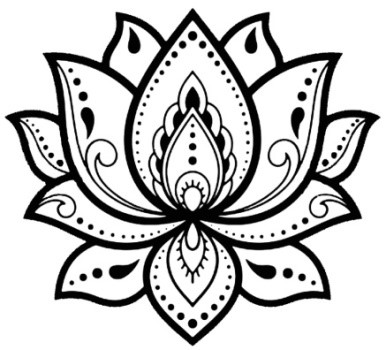
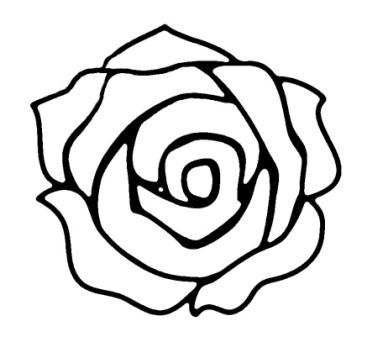
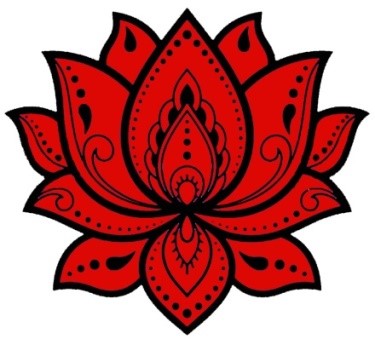
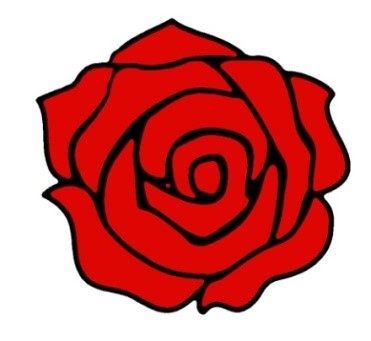
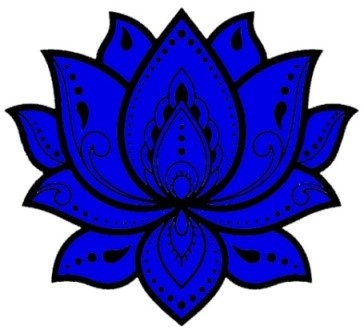
As we meditate, we visualise a lotus or a rose on our forehead, on the throat and on the chest near the heart (see below). You are free to opt for either an “eastern” lotus or a “western” rose. In the Guru Yoga in Tibetan tradition, the colours white, red and blue represent, respectively, the forehead, throat and heart chakra. They differ from the classic chakra colours and sometimes from our spontaneous feeling. After all, we generally associate the colour “red” with the heart, yet in guru yoga, that is represented by “blue”. I consciously chose the Tibetan vision because I did not simply want to ignore the century-long experience of that tradition.
- Intention or affirmation
The creative power of intention or affirmation is well known. Intention is the power behind the wish and generates a flow of energy. When you place an intention, you direct both your conscious and unconscious mind at a target and you are prepared to do everything that is needed to make that intention succeed. The best moment for placing an intention is at the beginning of your meditation. With Rabbi Yoga we frame a number of these. We do this in a positive way. Not in the negative sense I learned as a child: thou shalt not sin “in thought, word or deed”. In our exercise, we ask Jesus to plant or sow the seed of positive, right “thoughts, words and deeds”.
Here we come across the term “karma”. Karma (Sanscrit) means deed or action (operation). That “deed” covers thought, word and action. Karma is the result of your positive and negative thoughts, words and deeds. It is the law of cause and effect, whereby everything you think, speak or do ultimately comes back to you. Your attitude behind the “deed” is crucial here. We totally attune our attitude to Jesus.
- Mala
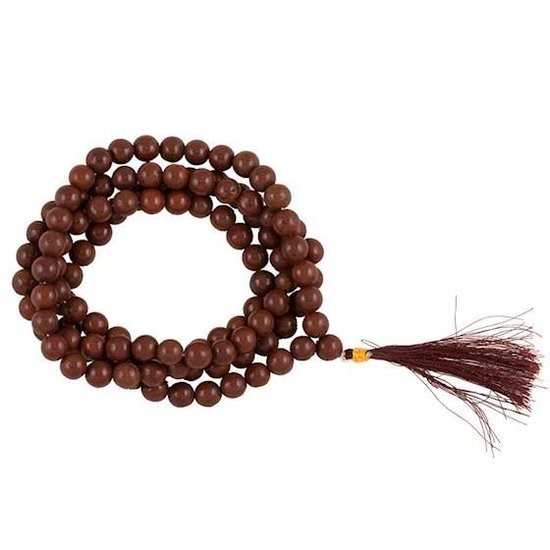
During the meditation, we repeat a specific number of breathings and/or mantras. As an aid to counting, we make use of a mala or prayer beads, so that you don’t have to keep count in your head. After all, we have our plate full with the visualisations. You can also use a rosary. In order not to lose ourselves in the mechanical rattling off of the decades, we opted for two complete breathings per bead instead of one. The mala has 5 x 10 beads (5 decades), each decade separated by an intermediate bead (Lord’s Prayer bead). In the Buddhist tradition, people recite the mantras 108 times – a holy number. If you complete the mala or the rosary twice, you also arrive at 108 (5 x 10 Hail Mary pearls plus 4 Lord’s Prayer beads). You can make a mala yourself. A friend made a few for me using the wooden beads of a discarded fly curtain! In this way, an ordinary utility item was transformed into a spiritual object.
RABBI YOGA PRACTICE
Keep watch over your thoughts,
soon they will become your words
Keep watch over your words,
soon they will become your deeds
Keep watch over your deeds,
soon they will become your habits
Keep watch over your habits,
soon they will become your character
Keep watch over your character,
soon that will become your destiny
Place or affix the illustration of Jesus slightly higher than where you sit, so that you look up to Him. To show your devotion and love you can, at the start of the meditation, offer incense, a flower or lit a candle. This small ritual allows you to attune yourself to your BelovedTeacher and create for yourself a suitable frame of mind. To set the right tone, I begin the day with Rabbi Yoga with Jesus. He is, as embodiment of right thinking, right speaking and right acting, my sadguru or self achieved True Teacher. These three aspects form the core of the current exercise which aims at becoming one with our Beloved Master.The exercise – a combination of mantra meditation, visualisations and intention or affirmation – takes place in 5 stages in which you evolve, step by step, towards becoming one with Jesus.
During the visualisations, it is not coincidental that use is made of the metaphor of “the sower”. “Sowing” is generally used to express something negative. Hate and division are sown, so too are panic and doubt, and extremists sow death, destruction and decay. But there is also a positive type of sowing, something Rabbi Jesus uses by means of parables. Saying 9 of the Gospel of Thomas: “Jesus said, Now the sower went out, took a handful and scattered them. Some fell on the road; the birds came and gathered them up. Others fell on the rock, did not take root in the soil, and did not produce ears. And others fell on thorns; they choked the seeds and worms ate them. And others fell on the good soil and it produced good fruit: it bore sixty per measure and a hundred and twenty per measure.” In the three synoptic gospels, this is His first parable. (Matthew 13,1-23; Mark 4,1-20; Luke 8,4-15). This sowing metaphor is also found in another guise: “The kingdom of heaven is like a mustard seed, which a man took and planted in his field. Though it is the smallest of all seeds, yet when it grows, it is the largest of garden plants and becomes a tree, so that the birds come and perch in its branches.” (Matthew 13, 31-32). Here, Jesus captures the essence of his message in a natural image that is comprehensible for everybody.
During our meditation Rabbi Jesus sows the seed of right thoughts, right words and right deeds. We open ourselves as fertile soil and are, as you will see, connected to Him by at least three infusions. What is meant by “right”? “Right” is not necessarily what is politically correct, nor what is scientific or rationally sustainable or what morality prescribes. Everything that we, as the circumstances demand, think, put into words or do from our heart and not from our limited self, is “right” thinking, speaking and acting. “Speaking” also means writing and communicating in the widest sense of the word. The “right insight” means grasping that we are not an separate individual, not one person separated from the whole, but that everything is interdependent and united in G*d. During the meditation, we do not think about how the three intentions or affirmations will actually be achieved in our daily life. We trust that the meditation will do its work at a deeper level. Everything is in constant flux. Sometimes we experience this as negative and painful. But it is really something positive, because it can also cause us to change and help us develop our deepest potential by means of our meditation practice.
- First decade
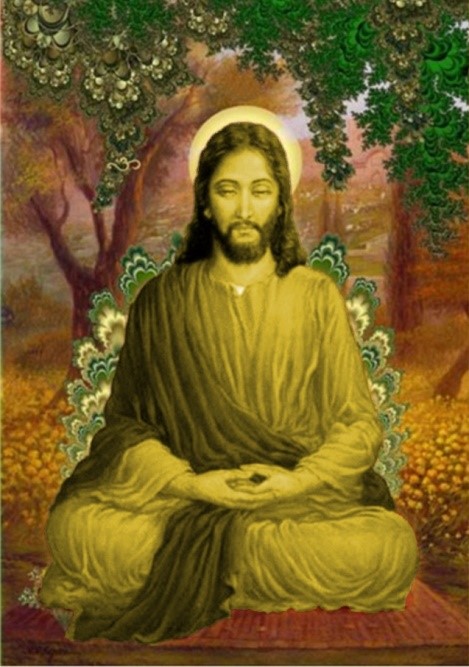
Imagine that Rabbi Jesus emits a golden Light that shines down on you and in which you bathe as you would in the sun. A spiritual solarium. Breath in the golden Light through your heart and feel, when you breathe out, how your whole body is filled by and soaked in this wonderful Light. Generate a living and intimate connection with the Rabbi.
Recite this intention or affirmation: “I open the barred doors of my chest and expose my heart to Your Light and Love, Rabbi Jesus, that streams in and fills my body to all my fibres and cells and then flows out onto the street, the city and the world to the well-being of all it touches.”
Start your recitation of the mantra: breathe in “Ma”, breathe out “Ra” (1st complete breath), breathe in “Na” and breathe out “Tha” (2nd complete breath).
At each mala or rosary bed, you recite the complete mantra once, in other words, two complete breaths. Repeat the mantra ten times to the rhythm of your breathing in and out.
- Second decade
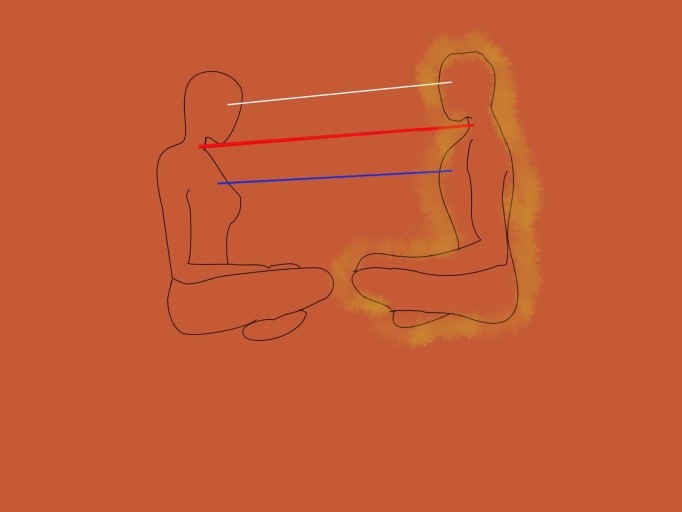
At the first “Lord’s Prayer bead”, you frame this intention or affirmation: “Rabbi Jesus, plant and sow in me the seed of right thoughts and allow the white lotus / rose of right thinking (the right insight) to grow and blossom in me.”
Imagine that a ray or beam of white light is flowing from Jesus’ white lotus / rose into you and filling you with the energy of “right thinking”. Feel how the white lotus / rose of right thinking opens under Jesus’ radiant white Light.
Start your recitation of the mantra: breathe in “Ma”, breathe out “Ra” (1st complete breath), breathe in “Na” and breathe out “Tha” (2nd complete breath). Breath from your forehead chakra.
At each mala or rosary bed, you recite the complete mantra once, in other words, two complete breaths. Repeat the mantra ten times to the rhythm of your breathing in and out.
During this decade, continue to feel the infusion with Jesus.
- Third decade
At the second “Lord’s Prayer bead”, you frame this intention or affirmation: “Rabbi Jesus, plant and sow in me the seed of right words and allow the red lotus / rose of right speaking to grow and blossom in me.”
Visualise a red lotus / rose at Jesus’ throat and at your own throat (throat chakra). See illustrations: Jesus in the lotus position with the three lotuses or roses and the drawing
Imagine that a ray or beam of red light is flowing from Jesus’ red lotus / rose into you and filling you with the energy of “right speaking”. Feel how the red lotus / rose of right speaking opens under Jesus’ radiant red Light.
Start your recitation of the mantra: breathe in “Ma”, breathe out “Ra” (1st complete breath), breathe in “Na” and breathe out “Tha” (2nd complete breath). Breath from your throat chakra
At each mala or rosary bed, you recite the complete mantra once, in other words, two complete breaths. Repeat the mantra ten times to the rhythm of your breathing in and out.
During this decade, continue to feel the infusion with Jesus.
- Fourth decade
At the third “Lord’s Prayer bead”, you frame this intention or affirmation: “Rabbi Jesus, plant and sow in me the seed of right words and allow the blue lotus / rose of right acting to grow and blossom in me.”
Visualise a blue lotus / rose at Jesus’ heart and at your own chest (heart chakra). See illustrations: Jesus in the lotus position with the three lotuses or roses and the drawing
Imagine that a ray or beam of blue light is flowing from Jesus’ blue lotus / rose into you and filling you with the energy of “right acting”. Feel how the blue lotus / rose of right acting opens under Jesus’ radiant blue Light.
Start your recitation of the mantra: breathe in “Ma”, breathe out “Ra” (1st complete breath), breathe in “Na” and breathe out “Tha” (2nd complete breath). Breath from your heart chakra
At each mala or rosary bed, you recite the complete mantra once, in other words, two complete breaths. Repeat the mantra ten times to the rhythm of your breathing in and out.
During this decade, continue to feel the infusion with Jesus.

- Fifth decade
At the fourth “Lord’s Prayer bead” you say: “Rabbi Jesus, today I radiate the golden Light of the Christ-nature to everything and everyone.” The “Christ-nature” is, as an analogy with the “Buddha-nature”, our / the true undivided state, the essence behind the world of apparitions, the pure consciousness that permeates the entire creation, G*d.
Visualise that you body is filled with golden light and that you are radiating this light to the world. You have become, as it were, the golden Jesus of the first decade. You have absorbed, incorporated Jesus, you are one with Him and you shall think, speak and act today as Rabbi Jesus would have done.
Start your recitation of the mantra: breathe in “Ma”, breathe out “Ra” (1st complete breath), breathe in “Na” and breathe out “Tha” (2nd complete breath).
At each mala or rosary bed, you recite the complete mantra once, in other words, two complete breaths. Repeat the mantra ten times to the rhythm of your breathing in and out.
During this decade, keep feeling and radiating the inner Christ.
As conclusion to the meditation, say this closing prayer:
“Rabbi Jesus, today I live from the Christ-nature
and I have become a living Jesus in thought, word and deed”.
Ask yourself the question:
Which thought is better than non-thinking?
Which word is better than non-speaking?
Which act is better than non-acting?
I personally begin the day with Rabbi Yoga in order to inject the spirit of right thinking, speaking and acting into everything that I undertake. That morning meditation determines the tonality of the music of my day. In other words, it conditions me to think, to speak and to act as Jesus would have done. I generally repeat the Rabbi Yoga in the afternoon. In the evening, when all activities have ceased, I exercise non-dualistic Christian meditation or Zen meditation (zazen): just sitting, just being, just resting in the open space or Emptiness or in G*d.
When you leave your meditation area and enter your personal and public space, you regularly remember how your golden radiation touches everything that passes by or that catches your eye.
Meditation is a long path; the aim is not for rapid success. Perhaps meditation is first and foremost an exercise in patience. Training patience = exercising meditation. Leave everything to the good care of Rabbi Jesus.
Perhaps there are others who have developed a similar meditation method. I would like to contact them.
RABBI JESUS YOGA IN A GROUP
An illustration of Rabbi Jesus is present and is visible to all participants. At the start of the session, incense can be burnt or a candle can be lit.
The meditation follows a slightly different course than that of an individual private exercise. The mentor is the only one who uses the mala and keeps an eye on the count and the time.
If you are contacted in advance by someone showing interest, point them to this blog and suggest that they first try Rabbi Yoga at home before taking part in a group meditation. When they participate for the first time, ask them to arrive half an hour early. An initiation takes longer than 5 minutes. The text below can also be given to them in the form of a small brochure.
Depending on the personal experience of the participants and the presence of newcomers, there are various possibilities in which the mentor can guide the practitioners through the five stages.
- At the start of each stage, the mentor strikes a gong or singing bowl and intones the introductory intention or affirmation out loud.
- If there are no newcomers present, he can limit himself to striking the gong and leaving the participants to frame the intention in silence and move on to the following stage.
- The practitioners do not need to use a mala; they can concentrate fully on the mantra meditation and the visualisations.
A “Rabbi Yoga” group session lasts half an hour. An individual meditation at home lasts at least twenty minutes. To achieve half an hour, the fifth and final stage is continued until the meditation time is completed, in other words two or three decades extra.
After the final stroke of the gong, the meeting is brought to an end with this prayer that is spoken aloud by all those present: “Rabbi Jesus, today I live from the Christ-nature and I am a living Jesus in thought, word and deed.”
WISHES
It is my wish that those who feel called
should develop a Rabbi Jesus Yoga meditation practice.
It is my wish that like-minded people find each other
and that Rabbi Jesus Yoga meditation groups emerge.
It is my wish that the meditation shall, except for the costs of operation,
be offered free of charge.
It is my wish that Rabbi Jesus Yoga groups seek contact with each other
and thus form a new worldwide Rabbi Jesus Yoga network.
It is my wish that a woman or man should come forward
and take the lead in this.
It is my wish that whoever sets to work with this,
whether individually or in a group,
contacts me.
MARANATHA
 Rabbi Jezus Yoga